THE INTERVIEWS
The interviews, conducted to help you discover a fulfilling career by tracing the journeys of people who have a passion for their work, come out of our yearly tours and from people we have the pleasure of speaking with between tours.
Steve Cody
Stretch the Line, From Bottom to Punch
June 20, 2008 | by brett | Permalink
Steve Cody, the co-founder of the public relations firm Peppercom, has a unique answer to anyone who asks him the number one cocktail question. His answer starts with his passions but leaves the door open by informing the questioner he is in the public relations field.
For example, Steve’s opening answer would be something like, “My passions are stand-up comedy and mountain climbing. I’m training to climb Mount Kilimanjaro in December. I also work in public relations.”
If the questioner continues to inquire about the public relations field, Steve tells them “I work for a mid-sized public relations firm in New York.” If they ask which firm, he says “Peppercom.” If they ask what he does there, Steve delivers the punch line, “I own it.”
Steve’s point is to not let the job define who you are. When I asked him our standard question to conclude the interview, he told me at 22 years old he was too conformist. He worried about what people thought of him.
“Don’t wait to stretch yourself,” Steve would tell his twenty-two year old self. “Now I’m doing stand up comedy and improv. I’m mountain climbing. And this is all in the last year. The more you stretch yourself, the more you challenge yourself, the better person you are going to be and the more respect you’ll get from others. That’s the number one thing I would do.”
Chris Pandolfi
Re-feeling the Feeling
June 19, 2008 | by brett | Permalink
Instead of staying at home on our one and only night in Nashville, our fearless ambassador, Emilee, drove us to the International Bluegrass Music Awards (IBMA) welcoming party at a hotel in downtown Nashville. The entire hotel was invaded by banjo players, fiddlers, and other bluegrass fanatics that wanted to get close to the artists they loved. In the lobby, players performed and fans mingled. Inside hotel rooms on every floor, impromptu performances naturally occurred while Nashville’s city lights gleamed in the distance. Emilee floated throughout the rooms, introducing us to potential interviewees.
One person we met was Chris Pandolfi, a banjo player from the Infamous Stringdusters group. Before he and his group won three awards the next night at the IBMA, including Song of the Year and Emerging Artist of the Year, he agreed to an interview during our time in Nashville.
“If you could go back to when you were twenty-three, and offer yourself just one piece of advice, what would you say to the twenty-three year old Chris?” I asked.
Chris Pandolfi doesn’t fit the stereotypical banjo player profile of a toothless, shoeless Bubba playing the banjo in overalls. He graduated from Dartmouth University where his friends went on to six figure salaries in investment banking. He took a theoretical approach to playing professionally by pursuing a higher education, becoming the first banjo principal at the Berklee College of Music in Boston. Eventually he moved to Nashville and helped begin what is now an award winning bluegrass group. Now twenty-seven, what would he say to himself at twenty-three?
“The twenty-three year old version of me was a lot braver than the current version,” Chris admitted. “I’d like to see what he’d say to me.”
His answer was in response to all of the expectations and pressure he had put on himself over four years. He was at a point in his professional career where he became daunted and self critical of his work. It wasn’t like he was twenty-three and possessed the excitement of learning a new instrument. He hit a wall comprised of pressure and expectations which he could not break through without doing something new.
Chris decided to buy a drum set. It was an instrument he always admired, so he temporarily put down the banjo and picked up a pair of drum sticks, playing all day and all night. He found in playing the drums, he made amazing strides in playing the banjo.
“It’s helped me go back in time and rediscover what it feels like to learn a new instrument and be so unafraid of the conventions. There’s no pressure. No professional expectations. It’s just this new outlet. I’m able to re-feel that feeling of life. And that’s the most potent feeling ever.”
Chris spoke like his twenty-three year old self was actually speaking to the twenty-seven year old version. He continued to subconsciously offer himself advice.
“When you’re not afraid, and you’re just chasing after something and don’t know any better, man you’re unstoppable.”
Steve Young
Right to Play
June 12, 2008 | by brett | Permalink
A couple months ago Zach and I represented the Jobing Foundation when we played in Steve Young’s Forever Young Foundation golf tournament. While lining up our shots on the 13th fairway, Steve meandered over hill with his head lowered in disgust as he searched for an errant tee shot. As he neared, Zach said, “Hey Steve, we would appreciate it if you could keep ‘em in your fairway today.”
Very rarely do you have the chance to heckle a Hall of Fame quarterback off of a football field. Even rarer is the chance that you get to interview someone regarded as a hero during your childhood. Luckily, we got the chance to do both.
Before we started the round, we also ran into Devon Harris, ambassador for Right to Play and member of the 1988 Jamaican Bobsled Team (which Cool Runnings was based on), and Ezekiel “Zeek” Sanchez, a founder of the Anasazi Foundation. Here’s the video…
Ray Karam
Perfecting a Flavor
June 6, 2008 | by brett | Permalink
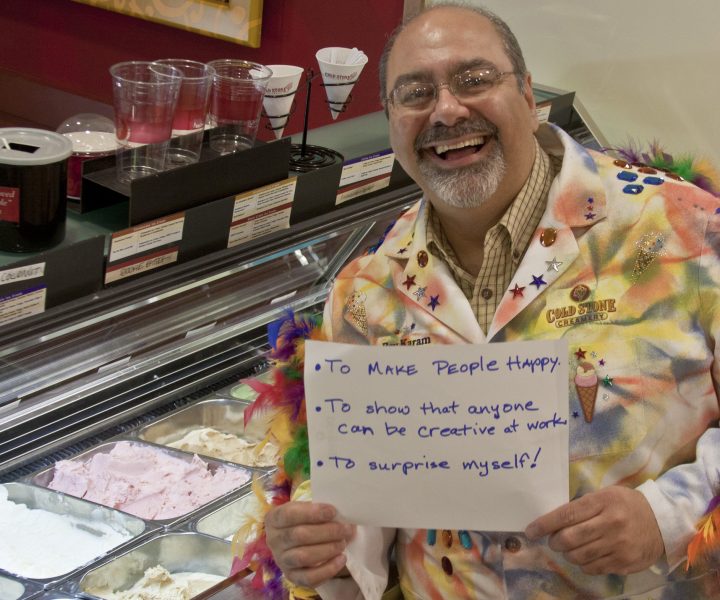
Ray Karam has one of the coolest job descriptions of anyone working- taste, innovate, and create new flavors of ice cream.
As the Senior Tastemaster for Cold Stone Creamery, the only time the Brooklyn born Ray stops talking about ice cream is when he pauses to sample a spoonful of one of his latest creations. Five to ten ounces of ice cream are consumed by Ray every day. Flavors like Blueberry Muffin and French Toast, along with a best seller like “Founder’s Favorite” are sampled for structure, texture, and of course, taste.
“I eat ice cream everyday,” Ray said in front of a case displaying thirty-two non traditional flavors. “I actually just had some.”
Ray didn’t exactly waltz into his dream job. He came to Arizona to be a teacher before coming across a job that spoke more to his passion of science. He met a man who held a job similar to what Ray holds today, and vowed to model himself after him.
“In the fifth grade, I was one of the kids who was a milk monitor,” Ray said, making the connection between his childhood and his career. “It was kismet that I would be in the dairy business all my life.”
When the position at Cold Stone opened, Ray did everything to get his foot in the door. He emailed, faxed, and cold called anyone who could give him a remote shot at an interview. He showed up on Monday morning with a shirt and tie- resume ready to be received and reviewed.
On that resume he had the credentials: undergraduate degrees in microbiology and chemistry, a graduate degree in food science, and over twenty years of working in the chilly dairy business for Nestle and Carnation. The skills were evident, but it was his will that separated Ray from the rest.
“I was so passionate about trying to get the job that they couldn’t help but give it to me,” Ray exclaimed enthusiastically.
Brett, a culinary school student from Rhode Island who recently turned an internship into a full time position with Cold Stone, admiringly listened to the interview with Ray while donning a white lab coat behind the counter. One couldn’t help but think that Ray had become the man he once modeled himself after, and by being a mentor to Brett, the cycle inevitably continues.
“It takes time to develop something,” Ray said in regards to perfecting a flavor. “You very rarely hit it on the first time.”
John W. F. Dulles
The Secret to Life
June 5, 2008 | by brett | Permalink
Noah set up an interview with a family friend who was a 94-year old Latin American history professor at the University of Texas. It was one of the best, most eccentric interviews of our project.
The framed black and white photos hanging from his office wall, some faded past the point of recognition, told the life stories of John W. F. Dulles. A photo of him shaking hands in a tuxedo brought back memories of his days in the Latin American mining business. He began as a muck stick laborer before utilizing his Harvard business education (class of ’37) to work his way up to Executive Vice President. The lovely woman on the wall was his wife of sixty-eight years.
Stacked high on his desk were notebooks of yellow lined paper; each sheet had words thoughtfully scrawled out in perfectly legible handwriting, double spaced for his assistant Ana to type. The first copy of Professor Dulles twelfth published book, Resisting Brazil’s Military Regime: An account of the battles of Sobral Pinto, arrived the day of the interview. Professor Dulles claimed it would be his last book because research is no longer possible due to computer illiteracy and the loss of mobility for his annual trip to Brazil.
The mobility in his right leg is still strong enough to make the seventy-five minute commute from San Antonio to Austin three times a week. He drives himself while listening to either an audio-book on cassette or a Houston Astro baseball game on the radio. He checks into a motel before settling into his office, which is located in a student dorm. He then leads a ninety-minute lecture to a captive audience of twenty students. At the time of the interview, Professor Dulles was beginning his 45th year of teaching at the collegiate level.
Professor Dulles had large, understanding eyes behind dark, thick glasses. He looked a lot like Larry King, only twenty years older with more disheveled gray hair. He actively asked questions when holes weren’t filled in a story, and held an inquisitive gaze with the person speaking to draw more information out them.
At a loss for questions and in complete awe of a man who lived a full life, Noah asked the cliché question we all would like to know the answer to: “What’s the secret to life?”
Without hesitation, Professor Dulles answered in a rhythmic voice, “Have a great interest in what one is doing and be active.” A long pause came and went as the culmination of ninety-four years of wisdom sunk in. “That helps ones attitude and prolongs one’s life. I wouldn’t want to sit around and watch television.”
Jim Sherraden
Manager and Janitor
June 4, 2008 | by brett | Permalink
Hatch Show Print is one of the oldest working letterpress print shops in the world, having been around since the invention of the light bulb. The shop is now a division of the Country Music Hall of Fame. The technology used today is the same it was when the shop opened in 1879. It essentially consists of taking hand crafted wood blocks with carved images and printing posters, using one color at a time. It’s a place where the designer is the printer and the printer is the designer. We made our way past the tourists, walking on the worn wood floors to the counter and asked to speak with Jim Sherraden, the manager and janitor of Hatch.
Jim is a native of Salina, Kansas and would be a great extra in a cowboy movie. He has a thick goatee with hints of emerging gray hairs. Mysterious, dark brown eyes challenge anyone they settle upon. He speaks with conviction and honesty, not only about his passion for Hatch Show Print, but about his life.
Leading us to the back of the shop, where thousands of designs imprinted on wood blocks are chronically ordered like books in a library, Jim began the interview by describing how he came to Hatch.
“I’m not lying when I say this,” Jim began, “but I came to Hatch at a time where I needed Hatch as much as Hatch needed me.”
Jim had no direction in particular while finishing up his schooling in his mid-twenties. As a waiter, Jim pursued his passion on the side by convincing a restaurant to display his wood cuts and linoleums. A Vanderbilt professor saw the quasi art exhibit and got a hold of Jim, saying he had to check out a dying poster shop before it went out of business. Jim visited the shop and instantly fell in love.
Feeling he could rescue the business from going under after operating for over a hundred years, he wrote the owner a proposal with what he felt he could do.
“Now here it is in 2007 and I have you guys talking to me, being two of over forty thousand people that come here a year,” Jim proudly stated.
Even in 2008, Hatch Show Print faces challenges of holding onto outdated technology while remaining profitable. When questioned about what he would do if the shop were to go under, Jim provided a thoughtful response and one of the most interesting answers we had heard.
“If the shop went away tomorrow, I hope I’m in a place where I could accept that. I think I am,” Jim said, pausing a moment to grasp the thought. “I don’t want it to happen. That same appreciation for history, both living and lost, is what I have knowing that I enjoy every day while it is living, and will have known that I enjoyed it to the fullest, if ever it becomes lost.”
“You can’t go back and wish,” Jim continued in his heartfelt manner, “I can’t get upset about history lost, knowing that I am in the process of making tomorrow’s history today.”
What Jim said to us struck me as profoundly important. This simple lesson easily applied to our tour, but was more significant to how people go about their everyday jobs. To say you enjoy your work while it occurs, and to know you enjoyed it to the fullest if it ever ceases to exist, is the pinnacle we all hope to reach.
Strawberry of 101.5 Jamz
The Airwaves
May 12, 2008 | by brett | Permalink
Gateway Early College High School is the first school to have adopted the Pursue the Passion program, where students venture into their community to interview people who hold jobs they are interested in. Gateway decided to purchase video cameras and edit clips of their interviews for their senior capstone class presentation. Today I attended Luis Omar Molina’s presentation, where he showed an interview he did with local radio host “Strawberry” of 101.5 Jamz.
Dave Santucci
Second Guessing Law School
May 8, 2008 | by brett | Permalink
Dave Santucci wanted to be a lawyer when graduating from Emory College (the Harvard of the South). He informally interviewed ten lawyers and asked them if he should pursue a career as a lawyer. Nine out of ten of them said he should consider an alternative career.
An internship with CNN led to a job as a producer. A highlight in his seven year career was going on a zero gravity simulator while reporting on science, space, and technology at NASA.
Now Director of Communications at the world’s largest aquarium, the Georgia Aquarium, Dave dives with whale sharks once a month while handling all communication issues. Quite a different life had he not talked to those ten lawyers.
John Condon
California Rivers Tours
January 12, 2008 | by brett | Permalink
It’s safe to say that John Condon knows Northern California’s Wine Country. A former deputy sheriff of Sonoma County turned Russian River kayak tour guide, John now loads passengers into his twelve seat van and carts them to the wineries that have made Sonoma and Napa counties a worldwide destination.
John’s California Rivers Tours picked us up for a little holiday wine tasting over the break, where our party of five set out to revisit our favorite locations while uncovering new ones. This was the first wine tour for three of us, so John took the reins and we were off for six hours of wine, sightseeing, and fun.
There were three things that I really enjoyed about the tour John took us on.
1) The word “complimentary.” In the past three or four wine tasting outings I’ve made with a guideless group of friends, I ended up forking over $5-$10 a winery for tasting fees. During our day we went to five wineries (Armida, Hop Kiln, Korbel, Harvest Moon, and Hook n’ Ladder) and not one winery made us dip into the wallet for tasting. So instead of dropping twenty-five dollars on fees, I was able to grab a great bottle of Zinfandel from Harvest Moon.
2) John’s lunch. When we were done with the champagne tasting at Korbel we joined John on a private patio, where a table full of goodies awaited us. The salmon we ate was caught by his son and smoked by John. The jam was from the berries he and his granddaughter hand picked. This, paired with a bottle of wine purchased earlier, was perfect. The meal broke up the day and allowed us some time to catch up. It is what John calls, “his differentiating factor that seperates his tour from all the others offered in wine country.”
3) John’s tidbits. As we cruised around a corner John told us to look under the bridge for people for steelhead. When we approached Hop Kiln, John had us smell a hop plant which he then identified as being part of the cannabis family. All the little things that you would never take notice of doing your own wine tour enhanced the experience that much more.
John’s website is www.calrivers.com. He is the owner and operator, and can be reached either by phone at (707) 579-2209 or by email at calrivers1(at)aol.com. He is one of the most reasonably priced (per group, groups 1-7, $50/hr, groups 8-12, $75/hr, lunch included) and experienced tour guides around, and I encourage you to give him a call if you’re thinking about seeing Wine Country.
The smoked salmon alone is worth it.
Noah Kagan
Passion as Forward Motion
November 20, 2007 | by Noah on the writeup.. Jay on the Video | Permalink
Noah Kagan, president of software development company Kickflip, will tell you what he does for a living, but don’t make that your lead if approaching him at a cocktail party. “I hate that question,” says the 25 year old Berkeley grad, who has worked for at least four separate companies that should have made him rich, if he had stayed around long enough. Although money is a final result, this self-proclaimed “results oriented guy” is more concerned with making decisions in the moment, not building his 401k. He quickly brushes over stories about Intel, Microsoft and Facebook to name a few, working his way toward current and future projects with far smaller companies.
Noah has a voracious appetite for action, something that is underappreciated in the world of large corporations. No bother. Noah finds places that fit his tastes, not the other way around. Money, to the Cupertino, CA native, has never been a driving force. Rather, Noah looks at jobs like relationships, investing emotionally, working hard, yet keeping in mind that it may just not be the perfect fit. It is an outlook that has made Noah a desired mind in just about any company, and has led him to start his own.